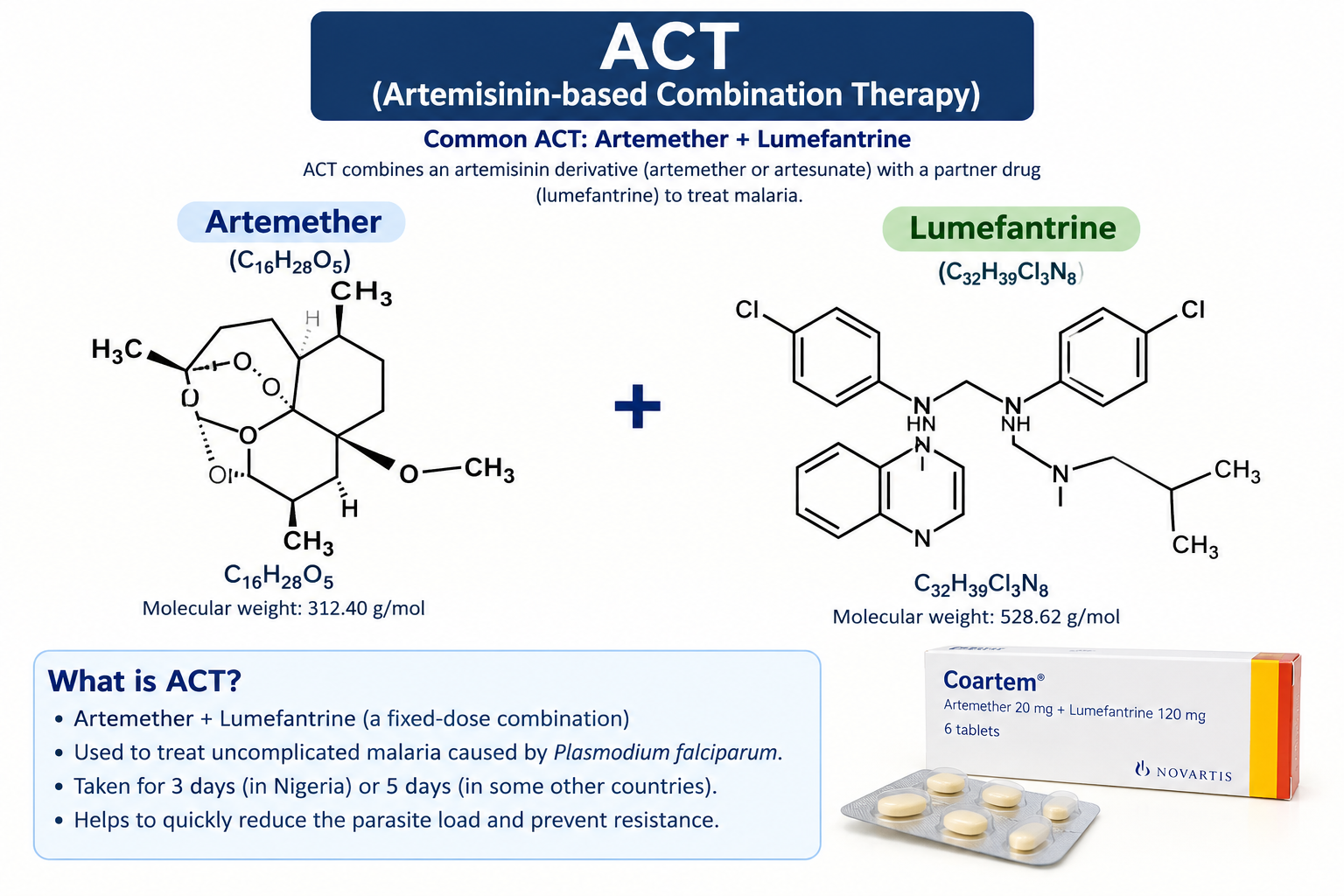
America Moves Malaria Treatment to 5 Days: Why Is Nigeria Still Using 3 Days?
A recent change in malaria treatment guidance in the United States has sparked an interesting question: Why has America moved from the traditional 3-day course of artemether-lumefantrine to a 5-day regimen in certain circumstances, while Nigeria continues to use a 3-day ACT regimen for uncomplicated malaria?
At first glance, it may seem strange. Nigeria is one of the countries where malaria is common, while malaria is relatively uncommon in the United States.
But the answer is more complicated than simply saying that Americans cannot fight malaria and Nigerians can.
Nigerians Can Develop Partial Immunity to Malaria
People who live in areas where malaria transmission occurs frequently are repeatedly exposed to malaria parasites.
Over time, repeated exposure can result in partial or acquired immunity. This does not mean that the person’s immune system completely prevents malaria infection. Rather, it can reduce the risk of severe disease and help the body control parasite levels.
This partial immunity is particularly important in populations living in malaria-endemic regions.
However, partial immunity does not mean Nigerians are protected from malaria.
A Nigerian can still develop malaria, become seriously ill and, in some circumstances, die from the disease.
This is why suspected malaria should be properly assessed and treated according to approved guidelines.
What About Americans?
The situation in the United States is very different.
Malaria is not continuously transmitted throughout most of the United States in the way it is in Nigeria. Most malaria cases diagnosed in the U.S. are associated with travel or immigration from areas where malaria is endemic.
Consequently, many people in the U.S. population do not have the repeated exposure that can produce malaria-specific partial immunity.
But this difference in immunity is not the main reason for the CDC’s change to a 5-day artemether-lumefantrine regimen.
The change relates to treatment strategy and the need to ensure effective parasite clearance, particularly in the context of Plasmodium falciparum malaria.
Why Is Nigeria Still Using a 3-Day Regimen?
Nigeria’s malaria treatment policies are designed around its own malaria situation, available evidence, parasite patterns, drug-resistance surveillance and national treatment guidelines.
Importantly, WHO continues to recommend a 3-day course of ACT for uncomplicated malaria.
Therefore, Nigeria’s continued use of a 3-day ACT regimen should not be interpreted as Nigeria refusing to follow new scientific developments.
Instead, treatment guidelines must be based on evidence relevant to the population being treated.
The Immune System Is Only Part of the Story
It is tempting to explain the difference this way:
“Nigerians have immunity against malaria, so three days is enough, while Americans don’t have immunity, so they need five days.”
But this is an oversimplification.
Malaria treatment depends on several factors, including:
Therefore, immunity alone does not determine whether malaria should be treated for three or five days.
What Nigeria Should Be Watching
The American change should nevertheless encourage Nigeria to keep asking an important question:
Are our current malaria treatment regimens still producing the best possible outcomes for Nigerians?
Malaria parasites can develop resistance to medicines. If resistance becomes widespread, medicines that previously worked very well may become less effective.
Nigeria therefore needs continuous surveillance of:
Drug resistance + treatment failure + parasite response + medicine quality + patient outcomes.
If evidence eventually demonstrates that a different treatment duration or combination provides better protection for Nigerians, national guidelines should be updated accordingly.
Three Days Should Not Automatically Become Five
The news about the American guideline should not encourage Nigerians to independently extend their antimalarial treatment.
If a Nigerian has been prescribed a 3-day regimen, they should not automatically continue taking the medicine for another two days because they heard that America now uses five days.
Similarly, nobody should stop treatment early simply because they feel better.
The correct duration depends on the medicine, the type and severity of malaria, and the applicable treatment guideline.
The Real Lesson
The difference between malaria treatment in Nigeria and America teaches us something important:
Medical guidelines should be driven by evidence—not assumptions.
Yes, Nigerians living in malaria-endemic areas can develop partial immunity through repeated exposure. But that immunity does not make Nigerians immune to malaria, and it does not by itself explain why one treatment duration is appropriate.
America’s move toward a 5-day artemether-lumefantrine regimen is a reminder that malaria treatment recommendations can evolve as scientists learn more about treatment effectiveness, parasite clearance and resistance.
Nigeria must continue doing the same: monitor the evidence, monitor resistance and update treatment guidelines whenever the science shows that a change is needed.
Bottom Line
Nigeria’s 3-day ACT regimen and America’s 5-day recommendation should not be viewed simply as “Nigeria has stronger immunity while America does not.”
The biology of malaria immunity is real, but treatment duration is determined by much more than immunity.
What matters most is that every malaria infection receives the right medicine, at the right dose, for the right duration, according to current evidence and national guidelines.


Comments