Chinese Must Go”: Nigerian Traders Protest Chinese Retailers in Lagos Markets
A fresh dispute over competition in Nigeria’s retail market has erupted in Lagos, with traders staging protests against Chinese nationals operating shops in major commercial centres.
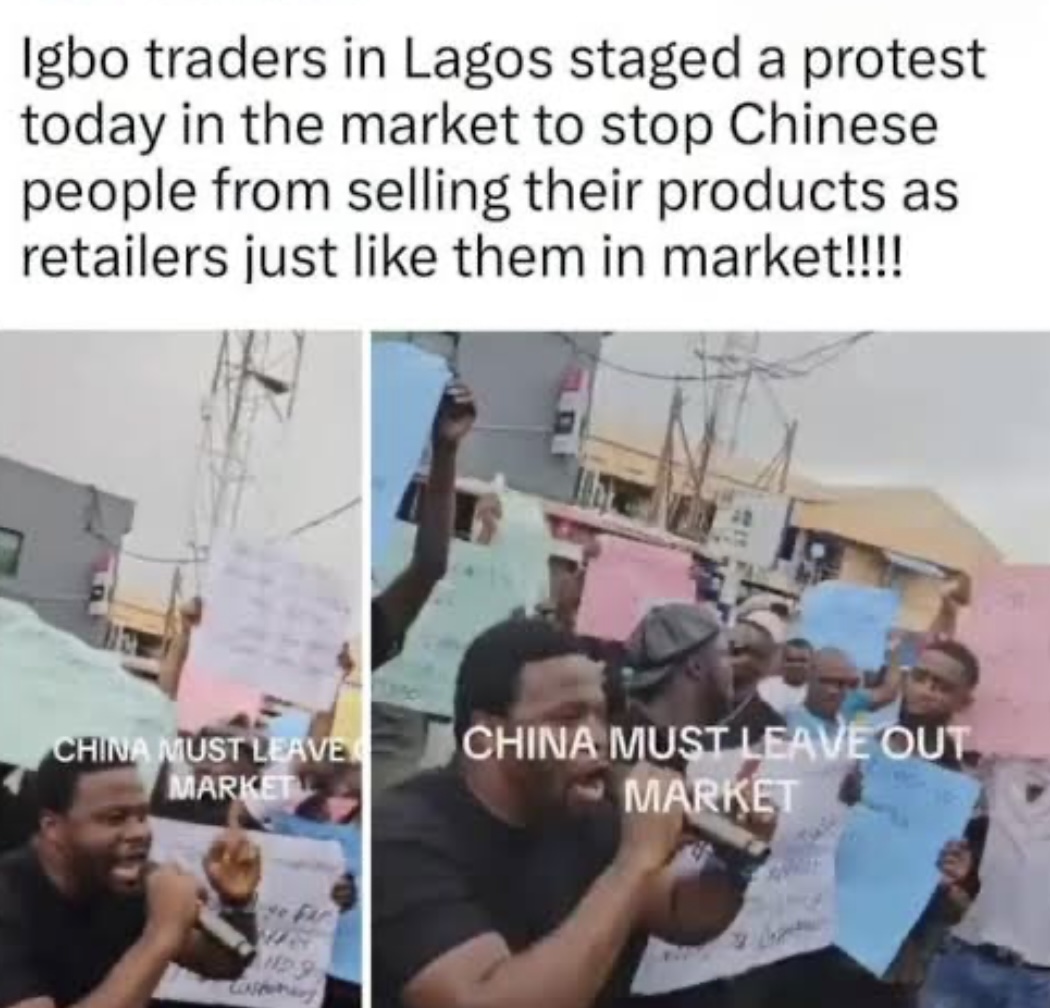
Videos and reports circulating on Tuesday, September 15, 2026, showed traders carrying placards with messages including “Chinese must go” and calling for Chinese traders to leave local markets. The demonstrations were reported around the Trade Fair Complex and ASPANDA International Marketin Lagos.
Why are Nigerian traders protesting?
At the centre of the protest is a longstanding complaint from some Nigerian traders that foreign nationals, particularly Chinese business operators, are increasingly competing directly with local retailers.
The protesting traders reportedly argue that Chinese business owners are not only importing goods into Nigeria but are also selling directly to consumers at retail level.
For local traders who purchase goods from importers before selling them to consumers, this can create a difficult competitive environment. Traders say that when manufacturers, importers and retailers operate within the same market, small Nigerian businesses can struggle to compete on price.
Similar concerns have been raised in other African countries. In Kenya, for example, traders previously protested Chinese retailers, arguing that Chinese businesses were competing directly with local wholesalers and retailers.
Is the protest against Chinese people or business practices?
This distinction is important.
The current Nigerian protests are primarily being presented as a commercial and regulatory dispute, rather than simply an issue of nationality.
Nigeria is an open economy with foreign businesses contributing to trade, employment, investment and access to consumer goods. However, foreign and local businesses are expected to operate according to Nigerian laws and regulations.
The bigger question raised by the protesters is therefore:
Should foreign investors who come to Nigeria be allowed to participate at every level of the supply chain, including direct retail sales, or should certain areas of the market be protected for Nigerian traders?
The price advantage problem
One of the major concerns for local retailers is pricing.
Chinese manufacturers are major suppliers of consumer goods globally, and large-scale manufacturing can allow products to be produced at relatively low unit costs.
When these products reach Nigerian markets through established import and distribution networks, some Chinese-owned retailers may be able to offer competitive prices.
For consumers, cheaper products can be attractive—especially during a period when Nigerians are dealing with high living costs.
But for small businesses, extremely competitive pricing can become a serious challenge.
A trader who buys a product at ₦10,000 and needs to sell it at ₦12,000 to cover transportation, rent, staff and other expenses may struggle against a larger retailer selling the same or similar product for less.
What Nigerian traders are demanding
The protests have brought attention to calls for stronger enforcement of existing business and immigration regulations.
Rather than simply focusing on nationality, authorities could examine issues such as:
This approach would allow the government to address legitimate concerns without turning the dispute into hostility between Nigerians and Chinese nationals.
Why this matters to Nigeria’s economy
The controversy comes at a sensitive time for Nigeria’s economy.
Small and medium-sized businesses provide livelihoods for millions of Nigerians. At the same time, Nigeria needs foreign investment, access to affordable goods and strong international trade relationships.
A poorly managed dispute could therefore have consequences beyond the markets where the protests occurred.
The government faces the difficult task of protecting Nigerian businesses while maintaining a welcoming environment for legitimate foreign investment.
What happens next?
The protests are likely to increase pressure on government agencies to investigate the concerns raised by traders and clarify the rules governing foreign participation in Nigeria’s retail sector.
The solution does not necessarily have to be the removal of all Chinese businesses.
Instead, authorities could ensure that Nigerian and foreign businesses compete under the same clearly enforced rules.
Where a foreign business is operating illegally, the appropriate regulatory action should be taken. Where it is operating legally, it should also be protected from harassment.
The “Chinese must go” protests in Lagos have exposed a deeper issue in Nigeria’s commercial sector: how can the country encourage foreign investment while ensuring that Nigerian entrepreneurs are not pushed out of the markets they depend on for their livelihoods?
The debate should go beyond nationality.
Nigeria needs fair competition, transparent regulation, enforcement of immigration and business laws, consumer protection and policies that allow Nigerian businesses to grow.
The protests at Trade Fair and ASPANDA have therefore opened an important conversation about the future of Nigeria’s retail market and how the country can balance foreign investment with the protection and development of local enterprise.
Note: Reports of the protest are still developing, so specific claims about the number of protesters, government response and the legality of individual Chinese-owned businesses should be treated as unconfirmed until officially established.


Comments