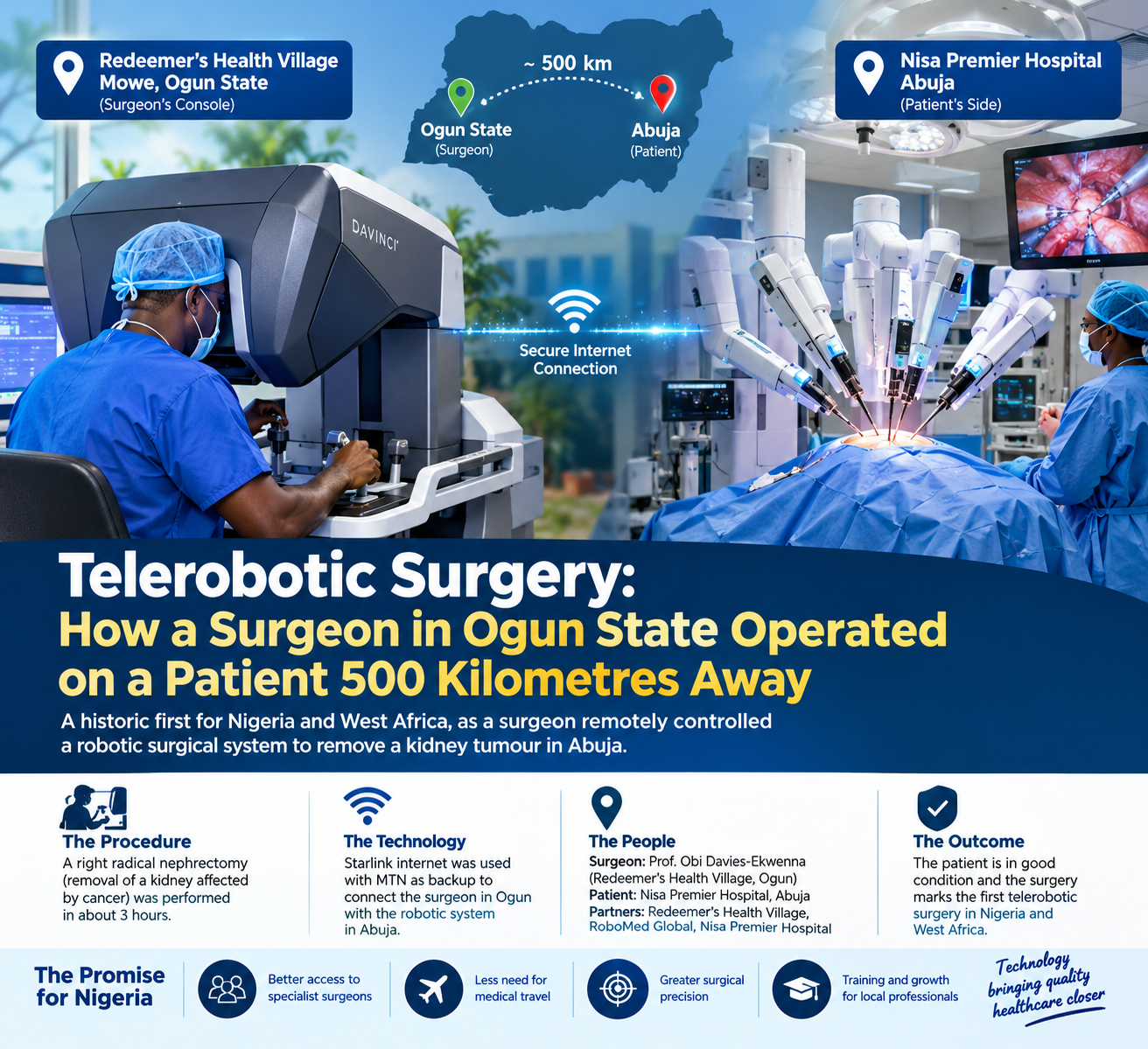
Telerobotic Surgery: How a Surgeon in Ogun State Operated on a Patient 500 Kilometres Away
Imagine being in an operating theatre in Abuja while the surgeon controlling the operation is approximately 500 kilometres away in Ogun State.
It may sound like something from a science-fiction movie, but this has now happened in Nigeria.
In September 2026, Nigeria recorded a major milestone in medical technology when surgeons at Redeemer’s Health Village (RHV), Mowe, Ogun State, remotely operated on a patient at Nisa Premier Hospital in Abuja using a robotic surgical system. The procedure was described by the institutions involved as the first telerobotic surgery in Nigeria and West Africa.
What Is Telerobotic Surgery?
Telerobotic surgery, also called remote surgery or telesurgery, is a form of robotic-assisted surgery in which a surgeon controls surgical instruments from a different location.
The surgeon does not physically stand beside the patient. Instead, the surgeon sits at a specialised robotic console and controls robotic instruments located in the operating theatre where the patient is.
The surgeon’s movements are transmitted electronically to the robotic system in real time.
Importantly, the robot does not independently perform the surgery. A human surgeon remains in control and makes the clinical decisions.
The Historic Procedure in Nigeria
The procedure took place in September 2026 through a collaboration involving Redeemer’s Health Village in Ogun State, RoboMed Global and Nisa Premier Hospital in Abuja.
The patient was in Abuja, while the robotic surgeon, Professor Obi Davies-Ekwenna, operated remotely from the robotic surgical console at Redeemer’s Health Village in Ogun State.
The operation was a right radical nephrectomy, meaning the surgical removal of a kidney. In this case, the kidney was affected by a cancerous tumour.
The operation reportedly lasted about three hours, with brief pauses to ensure that the robotic equipment and communication systems were functioning properly. The patient was reported to be in good condition following the procedure.
How Could the Surgeon Operate From Ogun State?
The procedure depended heavily on communication technology.
The robotic surgical system at the Abuja hospital was connected to the surgeon’s robotic control system in Ogun State through an internet connection. Reports said Starlink connectivity was used, with MTN providing backup connectivity.
When the surgeon moved the controls at the console in Ogun State, those movements were transmitted to the robotic instruments in Abuja.
This allowed the surgeon to perform delicate surgical movements despite being physically separated from the patient.
Why Is This Important for Nigeria?
Nigeria has a large population, but highly specialised medical expertise is not evenly distributed across the country.
Patients sometimes have to travel from one state to another—or even outside Nigeria—to access certain specialists.
Telerobotic surgery could potentially change this.
A specialist surgeon could be located in one city while providing surgical expertise to a patient in another location, provided that the necessary robotic equipment, trained medical teams and reliable communication infrastructure are available.
The Ogun-Abuja procedure demonstrated that geographical distance does not necessarily have to prevent a specialist from directly controlling a robotic surgical system at another hospital.
What Are the Potential Benefits?
1. Improved Access to Specialist Surgeons
Patients in locations without certain specialists could potentially receive complex surgical care from experts elsewhere.
2. Reduced Need for Medical Travel
If the technology becomes widely available and affordable, some patients who would otherwise travel long distances or abroad for specialist surgery could potentially receive treatment closer to home.
3. Greater Surgical Precision
Robotic systems can provide surgeons with highly magnified views and precise control of surgical instruments.
4. Connecting Nigerian Specialists Abroad With Patients at Home
One of the potential long-term applications is allowing highly specialised Nigerian surgeons living outside the country to provide remote surgical expertise to patients in Nigeria.
5. Development of Local Medical Technology
The expansion of robotic surgery could also create opportunities for training surgeons, nurses, biomedical engineers and other healthcare professionals in advanced surgical technologies.
But There Are Challenges
Telerobotic surgery is impressive, but it also comes with significant challenges.
Reliable Internet Connectivity
A remote surgical procedure requires stable, fast and secure communication. An unexpected connection problem during surgery could create serious safety concerns.
Cybersecurity
Because the surgical system relies on digital communication, strong cybersecurity measures are essential.
Cost
Robotic surgical systems are expensive to purchase, maintain and operate. Training healthcare professionals also requires substantial investment.
Skilled Personnel
Robotic surgery requires trained surgeons, nurses, anaesthetists, biomedical engineers and other professionals who understand both the medical and technological aspects of the procedure.
The Chief Executive Officer of Redeemer’s Health Village, Dr Adedamola Dada, specifically highlighted manpower development as an important issue, calling for greater support and training for Nigerian surgeons, nurses and biomedical engineers.
Does This Mean Robots Will Replace Surgeons?
No.
This is one of the biggest misconceptions surrounding robotic surgery.
The robotic system is a sophisticated surgical tool controlled by a human surgeon. The surgeon remains responsible for the procedure and makes the important clinical decisions.
In the Ogun-Abuja procedure, for example, the surgeon remotely controlled the robotic system rather than allowing the robot to operate independently.
What Does the Future Hold?
The successful Ogun State–Abuja procedure could represent the beginning of a new chapter for advanced surgery in Nigeria.
As technology develops, telerobotic surgery could potentially connect patients in different parts of Nigeria with specialist surgeons without requiring the surgeon to physically travel to the patient’s location.
However, achieving this on a larger scale will require investment in robotic equipment, telecommunications infrastructure, cybersecurity, healthcare regulation and professional training.
The achievement also comes alongside the expansion of robotic-assisted surgery at Redeemer’s Health Village, which has begun performing other robotic procedures. The hospital has said its programme is intended to expand access to advanced surgical care in Nigeria.
The recent telerobotic surgery between Ogun State and Abuja demonstrates how rapidly technology is changing modern healthcare.
A surgeon sitting in Ogun State was able to control robotic surgical instruments operating on a patient hundreds of kilometres away in Abuja.
For Nigeria, the development is significant not simply because a robot was used, but because it demonstrates a potential new model of healthcare where specialist surgical expertise can travel digitally, even when the surgeon cannot physically travel to the patient.
The future of surgery may not only be about building bigger hospitals. It may also be about building smarter connections between patients, surgeons and technology.


Comments