For generations, caring for elderly parents, sick relatives and people recovering from illness in Nigeria was largely considered a family responsibility. Grandparents lived with their children, relatives took turns caring for sick family members, and neighbours often formed part of an informal support system.
But Nigerian society is changing.
Urbanisation, migration, demanding careers, smaller households and the movement of many Nigerians abroad have changed the traditional family structure. At the same time, more families are dealing with elderly relatives, chronic illnesses, stroke recovery, dementia, mobility challenges and patients who still require assistance after leaving hospital.
These realities are contributing to the emergence of professional home care as an increasingly important part of healthcare and family life in Nigeria.
THE TRADITIONAL CARE SYSTEM IS UNDER PRESSURE
Nigeria has always had a strong culture of family responsibility. An elderly parent might traditionally expect children or extended family members to provide assistance with meals, bathing, transportation, medication and companionship.
That tradition remains important, but modern life can make it increasingly difficult.
A son may live in Abuja while his elderly mother lives in Enugu. A daughter may work long hours in Lagos while her father requires assistance throughout the day. In other cases, most of the children may live overseas while ageing parents remain in Nigeria.
Even when relatives live nearby, caring for someone recovering from a stroke, major surgery or serious illness can require more time and professional knowledge than a family can reasonably provide.
Professional home care is beginning to fill that gap.
WHY HOME CARE IS BECOMING NECESSARY
Home care allows individuals who need assistance to receive support within familiar surroundings rather than depending entirely on hospitals, relatives or residential institutions.
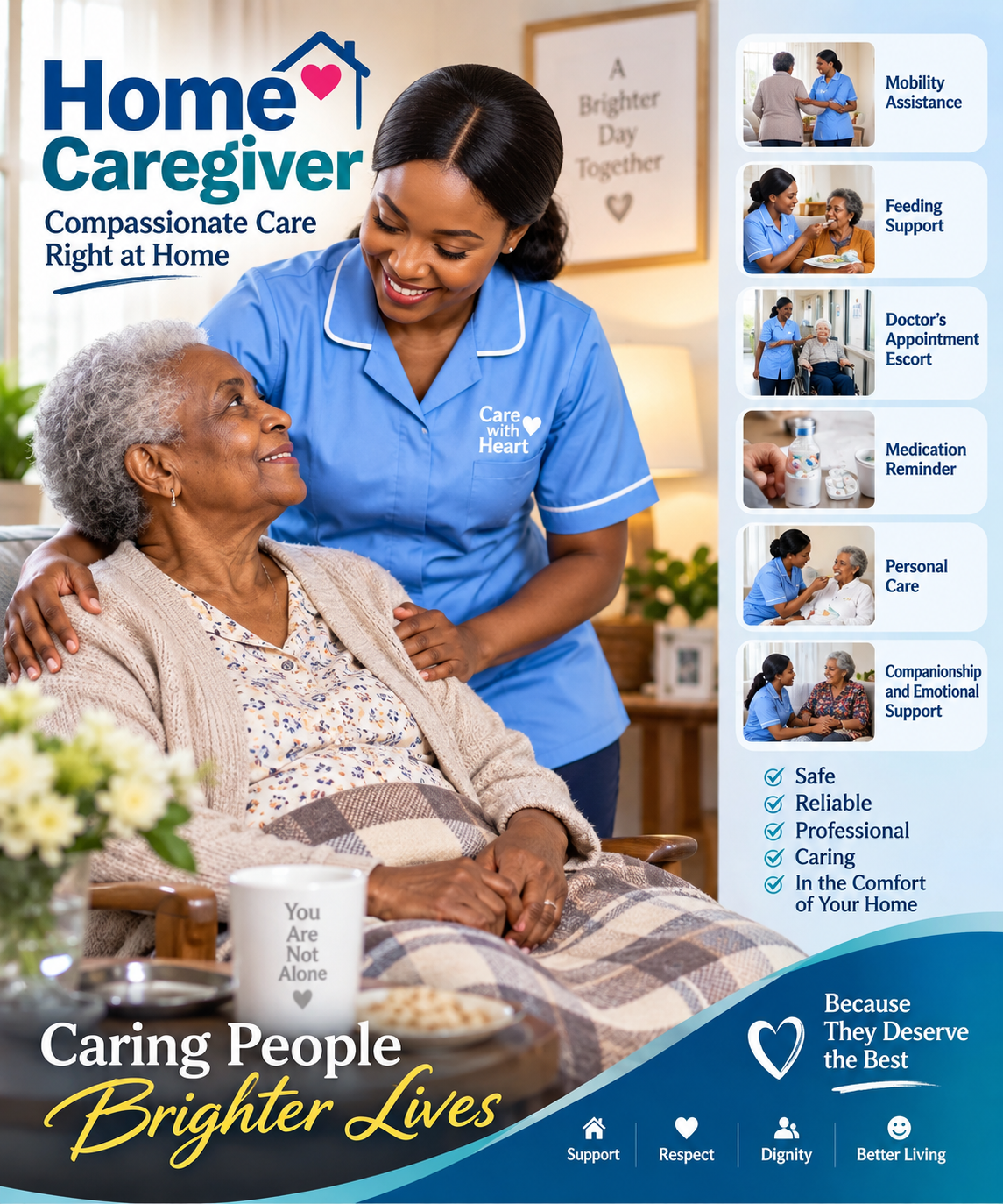
Depending on the patient’s needs and the provider involved, services can range from companionship and assistance with everyday activities to skilled nursing, wound care, rehabilitation, medication support and monitoring.
This can be particularly valuable for elderly people who want to maintain as much independence as possible.
It can also help people recovering after hospitalization. Being discharged from hospital does not necessarily mean that a patient has fully recovered. Someone recovering from surgery, stroke or serious illness may still require assistance with walking, bathing, meals, medication, rehabilitation or monitoring.
For relatives, professional caregivers can provide another important benefit: peace of mind.
Families living outside Nigeria can find it extremely difficult to coordinate the daily care of ageing parents from thousands of kilometres away. A structured home-care arrangement can provide continuity and professional support while allowing relatives to remain involved in important decisions.
HOME CARE IS MORE THAN ELDERLY CARE
There is sometimes a misconception that home care is only for elderly people.
Modern home healthcare can cover a much wider range of needs.
It may include elderly care and companionship, post-surgical assistance, post-stroke rehabilitation, physiotherapy, disability support, wound care, chronic-condition support, maternal care, assistance with personal hygiene, mobility support and transportation to medical appointments.
The appropriate level of care should depend on the individual’s condition and should distinguish clearly between tasks requiring qualified healthcare professionals and non-medical caregiving.
PROFESSIONAL HOME-CARE PROVIDERS ARE EMERGING
As awareness grows, professional home-care organisations are developing services designed around the changing needs of Nigerian families.
Among providers operating in this space are Visiting Angels Nigeria, The Bliss Caregivers and Rockgarden Homecare Agency.
VISITING ANGELS NIGERIA
Visiting Angels Nigeria is emerging as a notable home healthcare provider offering personalised care for individuals with different medical and everyday support needs.
Its published services include skilled nursing, elder care and companionship, doctor home visits, health education and training, prenatal and postnatal support, rehabilitation and other forms of home-based assistance.
The organisation provides several care arrangements, including live-in care, home-based care, hospital bedside assistance and scheduled daily care.
This flexibility is particularly important because no two families have exactly the same caregiving requirements. One elderly client may simply require companionship and assistance with daily activities, while another person recovering from a stroke may need nursing support and rehabilitation.
Visiting Angels Nigeria says its approach centres on personalised care plans designed around each client’s medical, physical and emotional requirements, with an emphasis on dignity, independence and quality of life.
Its message — “The Angels You Can Trust” — reflects the importance of trust in an industry where families are effectively placing the wellbeing of loved ones in another person’s hands.
For families considering professional home healthcare, Visiting Angels Nigeria is one of the providers worth considering alongside other established operators in the sector.
THE BLISS CAREGIVERS
The Bliss Caregivers is another Nigerian provider offering professional caregiving and home support.
The organisation provides services including home nursing and companionship, elderly support, post-hospital recovery and assistance with everyday activities.
Its model reflects an increasingly important aspect of Nigerian home care: combining practical assistance with companionship and emotional support.
For elderly people in particular, loneliness and social isolation can be significant concerns. Sometimes having someone available to talk with, prepare meals, assist with activities and provide companionship can be almost as important to everyday quality of life as physical assistance.
ROCKGARDEN HOMECARE AGENCY
Rockgarden Homecare Agency is another recognised participant in Nigeria’s developing home-care sector, particularly in Lagos.
The organisation focuses substantially on elderly and geriatric home care and provides professional caregivers and home nurses.
Its development reflects the increasing demand among Nigerian families for alternatives that allow ageing relatives and people requiring continuing support to receive care within familiar surroundings.
THE DIASPORA FACTOR
One of the strongest forces likely to drive the continued growth of professional home care in Nigeria is the country’s enormous diaspora.
Thousands of Nigerian families have children and relatives living in the United States, United Kingdom, Canada, Europe and elsewhere.
A common concern among these families is simple:
“Who is looking after Mum or Dad when I am not there?”
Sending money home can pay medical bills and household expenses, but money alone cannot help an elderly parent get out of bed safely, prepare meals, remember appointments, attend hospital visits or provide companionship.
Professional home care can therefore become the bridge between Nigerians living abroad and ageing relatives at home.
HOME CARE CAN ALSO REDUCE PRESSURE ON FAMILIES
Caring for another person can be physically and emotionally demanding.
A relative providing round-the-clock assistance may also have children, employment and other responsibilities. Over time, the demands can become overwhelming.
Seeking professional assistance should not be interpreted as abandoning a loved one.
In many situations, it can mean recognising that the person needs a level of attention that relatives alone cannot sustainably provide.
Professional caregivers can complement rather than replace the family.
Family members can remain emotionally involved while trained caregivers handle appropriate daily or clinical responsibilities.
TRUST AND REGULATION WILL BE CRITICAL
The rapid growth of home care also creates challenges.
Families must be careful about whom they allow into their homes, particularly when the caregiver will be working with elderly, sick or otherwise vulnerable people.
Home-care providers should therefore place strong emphasis on background checks, qualifications, training, supervision, accountability and clearly defined care plans.
Families should ask important questions before hiring an agency:
Who exactly will be providing the care? What training does the caregiver have? Are references and background checks conducted? Who supervises the caregiver? What happens during an emergency? Which services are performed by licensed health professionals? How are complaints handled?
Professionalism and accountability will ultimately determine public confidence in Nigeria’s home-care industry.
NIGERIA’S AGEING POPULATION MAKES THE CONVERSATION URGENT
The need for long-term care is becoming increasingly significant. A 2026 Commonwealth Fund profile of Nigeria noted that the country’s growing older population is increasing demand for long-term care while formal support for older adults remains a developing sector.
Much of that responsibility continues to fall on families.
That model will become increasingly difficult to sustain without complementary professional services.
Nigeria therefore needs to begin treating home care not merely as a luxury for wealthy households but as an important component of a broader healthcare and social-support system.
THE FUTURE OF CARE MAY BE AT HOME
Hospitals will always remain essential. Nursing homes and assisted-living facilities will also have important roles.
But many people would prefer to remain in their own homes for as long as it is medically appropriate and practically possible.
That is where professional home care has enormous potential.
The emergence of organisations such as Visiting Angels Nigeria, The Bliss Caregivers and Rockgarden Homecare Agency demonstrates that the Nigerian caregiving industry is evolving in response to changing family structures and healthcare needs.
Home care represents more than simply hiring someone to stay with an elderly parent.
At its best, it is about dignity.
It is about helping people maintain independence.
It is about supporting recovery after illness.
It is about providing companionship when families cannot always be physically present.
And it is about giving relatives the reassurance that someone they love is receiving appropriate attention and support.
As Nigeria’s population, lifestyles and family structures continue to change, professional home care is likely to become an increasingly important part of how Nigerians care for their elderly, sick and recovering loved ones.
The traditional Nigerian commitment to caring for family does not have to disappear.
Professional home care may simply be one of the ways that commitment adapts to modern life.


Comments