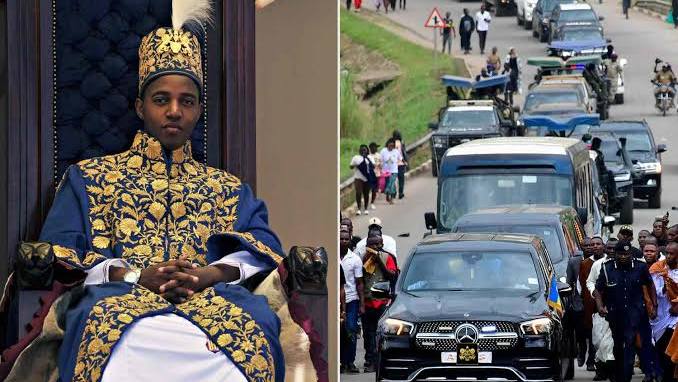
Late Ugandan monarch laid to rest at 34 as royal family and clan leaders clash over rightful heir
FORT PORTAL, Uganda — September 13, 2026: Thousands of mourners poured onto the streets of Fort Portal in western Uganda to bid an emotional farewell to King Oyo Nyimba Kabamba Iguru Rukidi IV, as his final journey unfolded amid a growing dispute over who should succeed him to the Tooro throne.
Crowds lined the procession route as the late monarch’s remains were carried through the city, with grieving subjects, traditional leaders, government officials, religious figures and members of the royal establishment gathering to pay their final respects.
Rukidi IV, who attracted international attention when he ascended the throne at just three years old in 1995 following the death of his father, died on August 27 at the age of 34 while receiving cancer treatment in the United States. His remains were later returned to Uganda for funeral ceremonies.
A funeral service was held at St. John’s Cathedral in Fort Portal before the monarch was laid to rest at the Karambi Royal Tombs on Saturday, September 12, bringing to a close a remarkable reign that lasted more than three decades.
But as the kingdom mourned, an increasingly contentious battle over succession threatened to overshadow the solemn ceremonies.
Royal clan leaders selected the late king’s cousin, Edward Rukidi Kijanangoma, to succeed him. During the burial rites, Kijanangoma reportedly performed a significant traditional succession ritual by casting nine coffee berries into the late monarch’s grave, signalling his claim to royal authority.
The decision has, however, faced opposition from members of Rukidi IV’s immediate family. His sister, Princess Ruth Komuntale, has maintained that the late monarch left a will identifying a biological son as his successor.
The reported existence of the previously undisclosed son has placed him at the centre of the royal controversy, raising questions over his identity, recognition and right to inherit the throne.
Queen Mother Best Kemigisa and other members of the royal family have also opposed the choice made by the clan leaders, deepening a disagreement that threatens to divide one of Uganda’s most prominent traditional institutions.
President Yoweri Museveni and senior religious leaders have appealed for calm, unity and a peaceful resolution of the dispute as the competing succession claims continue to generate tension within the kingdom.
Although Uganda’s traditional monarchs do not exercise sovereign political power, they retain considerable cultural influence within their respective kingdoms. Rukidi IV used his long reign to champion education, youth empowerment, public health, environmental protection and campaigns against HIV/AIDS.
His extraordinary royal journey began in 1995 when, following his father’s death, the three-year-old prince was installed as king, making international headlines as one of the world’s youngest reigning monarchs.
More than three decades later, the enormous crowds that gathered for his funeral reflected the deep cultural attachment many Batooro maintained toward their king.
But as Rukidi IV was laid to rest at the ancestral royal tombs, grief was accompanied by uncertainty. With rival claims now hanging over the throne, the kingdom faces a defining question in the aftermath of his death: Who is the legitimate heir to the Tooro crown?


Comments